
Mindfulness: In an Age of Distraction
Updated: 21 hours ago
The Modern Attention Crisis

We are living in an era of engineered distraction.
Smartphones, notifications, and constant digital input have normalized fragmented attention. Many people believe they are multitasking efficiently, but cognitive science tells a different story. Humans do not truly multitask. We task-switch. Each switch requires the brain to disengage one network of activity and activate another. This transition carries a measurable cognitive cost, increasing mental fatigue and reducing performance accuracy.
In a well-known study, heavy media multitaskers showed diminished attentional control and greater vulnerability to distraction compared to light multitaskers (Ophir, Nass & Wagner, 2009). In other words, chronic divided attention appears to weaken the very neural systems required to filter irrelevant information.
Attention is not just a psychological preference. It is a biological process that shapes neural architecture through neuroplasticity, the brain’s ability to strengthen circuits that are repeatedly activated. What we practice, we reinforce. Over time, habitual distraction may consolidate shallow processing while eroding sustained focus.
This concern is particularly important in childhood and adolescence, when executive control networks responsible for impulse regulation and emotional stability are still maturing. High-intensity digital stimulation during sensitive developmental windows has been associated with difficulties in sustained attention and self-regulation (Christakis et al., 2018).
The consequences extend beyond productivity. Attention influences memory consolidation, emotional regulation, and stress responsiveness. It determines whether we react impulsively or respond deliberately.
In a culture that fragments focus, the deliberate training of attention is no longer optional. It is foundational.
What Mindfulness Actually Trains
Mindfulness is frequently mistaken for relaxation, positive thinking, or an attempt to “empty the mind.” It is none of these. At its core, mindfulness is the deliberate training of attention.
More precisely, it strengthens three interrelated capacities: attentional stability, meta-awareness, and response inhibition.
Attentional stability refers to the ability to sustain focus on a chosen object, such as the breath or bodily sensation, without being carried away by distraction. When attention drifts, the practitioner notices and gently returns it. This repetition is not failure; it is the training stimulus. Each return reinforces neural circuits responsible for cognitive control.
Meta-awareness is awareness of awareness itself. It is the capacity to recognize that the mind has wandered. Without meta-awareness, distraction goes unnoticed. With it, individuals gain the ability to observe thoughts as events in the mind rather than facts that demand immediate reaction.
Response inhibition is the ability to pause before acting. In neurocognitive terms, this involves top-down regulation from frontal brain regions that modulate emotional and impulsive reactions. Mindfulness strengthens this regulatory capacity by repeatedly creating a gap between stimulus and response.
Importantly, mindfulness does not eliminate thought. It alters one’s relationship to thought. Instead of being automatically driven by internal narratives, individuals develop the ability to observe them with reduced reactivity.
This shift may appear subtle, but biologically it is profound. Attention is the gateway to perception, emotion, and behavior. Training attention strengthens the neural systems that govern them.
Mindfulness, therefore, is not passive. It is systematic cognitive conditioning.
Large-Scale Brain Networks and Attention
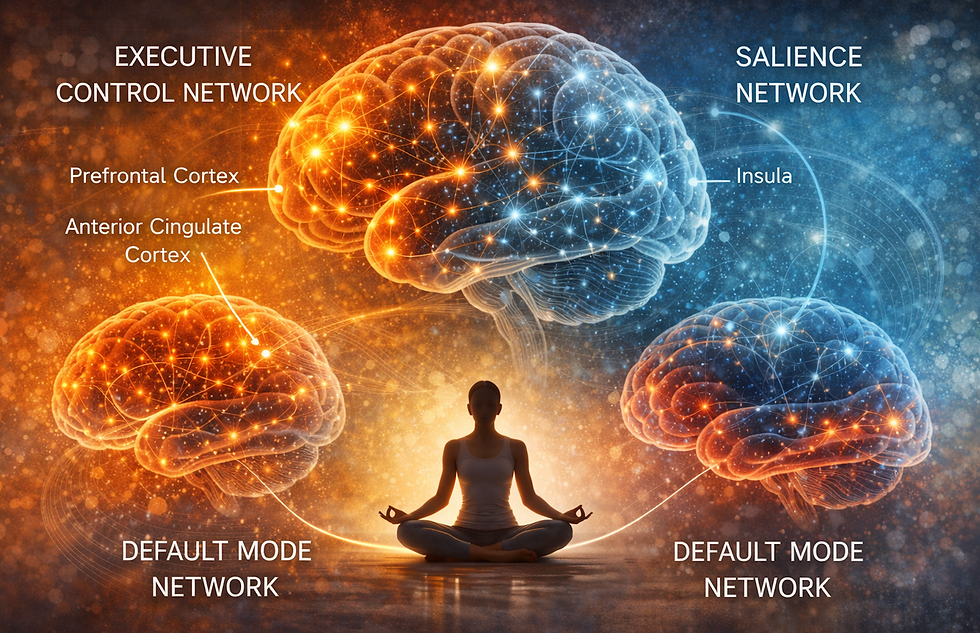
To understand how mindfulness reshapes the brain, it is helpful to think in terms of networks rather than isolated structures. The brain operates through coordinated systems, groups of regions that activate together to perform specific functions. Mindfulness appears to influence several of these large-scale networks in measurable ways.
One of the most important is the Executive Control Network, anchored in regions of the prefrontal cortex and the anterior cingulate cortex. The prefrontal cortex, located behind the forehead, is responsible for planning, decision-making, impulse control, and sustained attention. The anterior cingulate cortex plays a key role in monitoring conflict, detecting errors, and redirecting attention when the mind wanders. Neuroimaging studies have shown structural thickening and enhanced functional connectivity in these regions among mindfulness practitioners, changes associated with improved cognitive regulation (Lazar et al., 2005; Tang et al., 2010).
A second system is the Salience Network, which includes the insula, a region deeply involved in interoception, the perception of internal bodily signals such as heartbeat, breath, and visceral sensation. The salience network helps determine what deserves attention, whether an external stimulus or an internal sensation. Strengthening this network enhances self-awareness and emotional regulation.
Finally, mindfulness influences the Default Mode Network (DMN), a system active during self-referential thinking, mind-wandering, and internal narrative. Excessive DMN activity has been linked to rumination and anxiety. Research suggests mindfulness reduces maladaptive activation within this network and improves the ability to disengage from repetitive self-focused thought (Hölzel et al., 2011; Andrews-Hanna et al., 2021).
Taken together, these changes reflect a shift from automatic narrative processing toward deliberate attentional control. The brain becomes less reactive and more regulated, less scattered and more coherent.
Mindfulness does not quiet the brain by suppression. It refines how networks communicate.
Stress Regulation and the HPA Axis

Attention does not operate in isolation from physiology. How we direct attention influences one of the body’s most powerful regulatory systems: the hypothalamic-pituitary-adrenal axis, commonly called the HPA axis.
The HPA axis is a communication loop between the brain and the adrenal glands. When the brain perceives threat, the hypothalamus signals the pituitary gland, which then instructs the adrenal glands to release cortisol and adrenaline. In short bursts, this response is adaptive. It sharpens focus, mobilizes energy, and prepares the body for action.
The problem arises when stress becomes chronic. Persistent activation of the HPA axis disrupts normal cortisol rhythms. Under healthy conditions, cortisol rises in the morning to promote alertness and gradually declines toward evening to support sleep. Chronic stress can flatten this rhythm, leaving individuals simultaneously wired and fatigued. Dysregulation of this system has been associated with hypertension, metabolic syndrome, impaired immune defense, insomnia, and accelerated biological aging (Miller et al., 2007; McEwen & Akil, 2020).
Mindfulness appears to recalibrate this system rather than suppress it. Clinical studies show reductions in cortisol levels and improved parasympathetic activation following regular mindfulness practice (Pascoe et al., 2017). The parasympathetic nervous system, often described as the “rest-and-digest” branch, counterbalances the fight-or-flight response. When parasympathetic tone improves, heart rate variability increases, sleep stabilizes, and recovery processes strengthen.
Importantly, mindfulness does not eliminate stressors. It alters perception and reactivity. By repeatedly practicing non-reactive awareness, individuals reduce unnecessary amplification of stress signals. The HPA axis becomes less prone to chronic overactivation.
Health depends on rhythm. Mindfulness helps restore it.
Inflammation and Immune Modulation

Stress does not remain confined to the brain. It leaves biochemical fingerprints throughout the body, particularly within the immune system.
When the HPA axis is chronically activated, inflammatory pathways become upregulated. Inflammation is not inherently harmful; it is a protective response designed to eliminate pathogens and repair tissue. However, when inflammatory signaling remains elevated in the absence of infection or injury, it contributes to long-term disease risk. Elevated markers such as C-reactive protein (CRP) and nuclear factor kappa B (NF-κB), a transcription factor that regulates inflammatory gene expression, have been linked to cardiovascular disease, metabolic disorders, autoimmune conditions, and accelerated aging (Creswell et al., 2012).
Psychoneuroimmunology, the study of interactions between psychological processes, the nervous system, and immune function, provides a framework for understanding this connection. Chronic psychological stress amplifies inflammatory signaling. Conversely, practices that reduce stress reactivity can modulate immune responses.
Mindfulness appears to influence this axis of communication. Research suggests regular mindfulness practice is associated with reductions in inflammatory markers, including CRP and NF-κB activity, and improvements in immune cell function, including enhanced regulation of CD4+ T cells, which coordinate adaptive immune responses (Black & Slavich, 2016). These effects are moderate but consistent across multiple studies.
The implication is not that mindfulness replaces medical treatment. Rather, it modifies the internal environment in which disease risk develops. By reducing unnecessary inflammatory activation and supporting immune balance, mindfulness contributes to physiological resilience.
Attention, in this sense, becomes immunologically relevant.
Mindfulness and Cellular Aging

Aging is often measured in years, but it is also written into our cells.
At the ends of each chromosome lie structures called telomeres, protective caps composed of repetitive DNA sequences. They function much like the plastic tips on shoelaces, preventing genetic material from fraying during cell division. Each time a cell divides, telomeres shorten slightly. Over time, excessive shortening can impair cellular function and contribute to biological aging.
Chronic psychological stress accelerates this process. Elevated cortisol, persistent inflammation, and oxidative stress have all been associated with shortened telomere length (Epel et al., 2004). Individuals exposed to prolonged stress often show signs of accelerated cellular aging compared to less stressed counterparts.
Mindfulness appears to influence this pathway indirectly through stress regulation. Several studies have reported increased activity of telomerase, the enzyme responsible for maintaining and repairing telomeres, among individuals engaged in regular mindfulness practice (Blackburn et al., 2015; Rao et al., 2015). A meta-analysis suggests mindfulness-based interventions are associated with modest but measurable increases in telomerase activity (Schutte & Malouff, 2014).
It is important to interpret these findings cautiously. Mindfulness is not a cellular fountain of youth. The effects observed are moderate and influenced by many variables, including overall lifestyle and health status. However, the consistency of findings suggests that stress modulation may translate into measurable cellular benefits.
The implication is profound: the way we regulate attention and stress may influence aging at the molecular level.
Biology listens to psychological state more closely than we once believed.
Clinical and Practical Implications
The biological effects of mindfulness are not merely theoretical. They translate into measurable clinical relevance.
For practitioners, mindfulness represents a foundational regulatory intervention. In chronic pain, for example, altered activity within the default mode network and heightened amygdala reactivity can amplify suffering beyond tissue damage. Training attentional control helps patients observe pain sensations without immediately layering catastrophic interpretation onto them. This shift can reduce perceived intensity and improve functional outcomes.
In anxiety and trauma-related conditions, strengthening executive control networks enhances top-down modulation of limbic activation, allowing individuals to respond rather than reflexively react. For clinicians themselves, mindfulness has been associated with reduced burnout, improved emotional resilience, and enhanced therapeutic presence.
For the general reader, the implications are equally practical. Improved attentional stability supports deeper work, clearer decision-making, and more meaningful interpersonal connection. Stress regulation improves sleep quality and emotional steadiness. Reduced inflammatory signaling and better autonomic balance contribute to long-term health resilience.
Mindfulness does not replace medical treatment, psychotherapy, or structured rehabilitation. It augments them. By strengthening regulatory systems at multiple levels, cognitive, autonomic, and immune, mindfulness creates a more stable internal environment in which healing and performance can occur.
It is not an alternative intervention. It is a foundational one.
An Exercise You Can Try
Mindfulness does not require extended retreats or complex rituals. It begins with deliberate, consistent practice.
Start with five minutes daily. Sit upright in a quiet space. Allow the eyes to close or soften. Choose a single anchor for attention, most commonly the natural sensation of breathing. Do not attempt to control the breath. Simply observe it as it moves in and out.
Within seconds, the mind will wander. Thoughts, plans, memories, and distractions will arise. This is not a problem; it is the training stimulus. The critical step is noticing that attention has drifted. That moment of recognition, called meta-awareness, is the strengthening phase. Gently return attention to the chosen anchor without self-criticism.
Repeat this cycle throughout the session. Each return reinforces neural circuits involved in cognitive control and emotional regulation.
Consistency matters more than duration. Five focused minutes daily is more effective than occasional longer sessions. Over time, attentional stability increases, reactivity decreases, and awareness becomes more continuous.
Like physical conditioning, the benefits accumulate gradually.
References
Andrews-Hanna, J. R., Smallwood, J., & Spreng, R. N. (2021). The default network and self-generated thought: Component processes, dynamic control, and clinical relevance. Annals of the New York Academy of Sciences, 1481(1), 29–52.
Black, D. S., & Slavich, G. M. (2016). Mindfulness meditation and the immune system: A systematic review of randomized controlled trials. Annals of the New York Academy of Sciences, 1373(1), 13–24.
Blackburn, E. H., Epel, E. S., & Lin, J. (2015). Human telomere biology: A contributory and interactive factor in aging, disease risks, and protection. Science, 350(6265), 1193–1198.
Christakis, D. A., Ramirez, J. S. B., Ferguson, S. M., Ravinder, S., & Ramirez, J. M. (2018). How early media exposure may affect cognitive function: A review of results from observations in humans and experiments in mice. Proceedings of the National Academy of Sciences, 115(40), 9851–9858.
Creswell, J. D., Irwin, M. R., Burklund, L. J., Lieberman, M. D., Arevalo, J. M. G., Ma, J., & Cole, S. W. (2012). Mindfulness-based stress reduction training reduces loneliness and pro-inflammatory gene expression in older adults: A randomized controlled trial. Brain, Behavior, and Immunity, 26(7), 1095–1101.
Epel, E. S., Blackburn, E. H., Lin, J., Dhabhar, F. S., Adler, N. E., Morrow, J. D., & Cawthon, R. M. (2004). Accelerated telomere shortening in response to life stress. Proceedings of the National Academy of Sciences, 101(49), 17312–17315.
Hölzel, B. K., Carmody, J., Vangel, M., Congleton, C., Yerramsetti, S. M., Gard, T., & Lazar, S. W. (2011). Mindfulness practice leads to increases in regional brain gray matter density. Psychiatry Research: Neuroimaging, 191(1), 36–43.
Lazar, S. W., Kerr, C. E., Wasserman, R. H., Gray, J. R., Greve, D. N., Treadway, M. T., & Fischl, B. (2005). Meditation experience is associated with increased cortical thickness. NeuroReport, 16(17), 1893–1897.
McEwen, B. S., & Akil, H. (2020). Revisiting the stress concept: Implications for affective disorders. The Journal of Neuroscience, 40(1), 12–21.
Miller, G. E., Chen, E., & Zhou, E. S. (2007). If it goes up, must it come down? Chronic stress and the hypothalamic–pituitary–adrenal axis in humans. Psychological Bulletin, 133(1), 25–45.
Ophir, E., Nass, C., & Wagner, A. D. (2009). Cognitive control in media multitaskers. Proceedings of the National Academy of Sciences, 106(37), 15583–15587.
Pascoe, M. C., Thompson, D. R., Jenkins, Z. M., & Ski, C. F. (2017). Mindfulness mediates the physiological markers of stress: Systematic review and meta-analysis. Journal of Psychiatric Research, 95, 156–178.
Rao, X., Harrington, L. A., & Muehlenbein, M. P. (2015). Mindfulness and telomere length: A systematic review. Psychoneuroendocrinology, 58, 70–79.
Schutte, N. S., & Malouff, J. M. (2014). A meta-analytic review of the effects of mindfulness meditation on telomerase activity. Psychoneuroendocrinology, 42, 45–48.
Tang, Y. Y., Lu, Q., Fan, M., Yang, Y., & Posner, M. I. (2010). Mechanisms of white matter changes induced by meditation. Proceedings of the National Academy of Sciences, 107(35), 15649–15652.
.
DR. BRIAN ABELSON, DC. - The Author

Dr. Brian Abelson is a chiropractor, author, and educator with more than 30 years of clinical experience in musculoskeletal care, rehabilitation, and sports performance. His educational work focuses on musculoskeletal conditions, human movement, sports biomechanics, and evidence-informed approaches to treatment and rehabilitation.
He is the developer of Motion Specific Release (MSR) and Clinical Director of Kinetic Health in Calgary, Alberta, Canada.

Continue Learning with MSR Courses and MSR Pro
For Healthcare Practitioners
Motion Specific Release integrates assessment, clinical reasoning, manual therapy, exercise, and patient education within one adaptable approach to musculoskeletal care.
MSR Pro and MSR courses support different parts of that learning process:
Structured Clinical Education: MSR courses connect applied anatomy and biomechanics with orthopedic and neurological assessment, myofascial procedures, fascial expansions, joint mobilization, manipulation, and rehabilitation.
Hands-On Skill Development: Live training provides opportunities to refine palpation, patient positioning, force application, and clinical decision-making through practice and direct feedback.
MSR Pro Clinical Library: Members receive access to more than 200 MSR procedures, downloadable and fillable clinical forms, examination resources, rehabilitation progressions, and exercise-prescription materials.
Extensive Video Resources: More than 800 videos support examination, treatment procedures, exercise rehabilitation, and clinical application.
Patient Education: A library of 50 condition articles helps practitioners explain common musculoskeletal problems and provide patients with practical information.
Continued Development: Resources are updated as MSR courses and clinical education continue to evolve.
Videos and articles can introduce concepts, but hands-on proficiency develops through deliberate practice, feedback, and experience. MSR is designed to help practitioners connect technique with clinical reasoning and adapt care to the individual rather than apply the same protocol to everyone.
Explore MSR Pro | View Online and Live Courses
Disclaimer:
The articles and embedded videos on the MSR website are provided for educational and informational purposes only. They are not a substitute for individualized assessment, diagnosis, or treatment by an appropriately qualified healthcare professional.
Some videos demonstrate clinical examination and manual therapy procedures intended for licensed or regulated healthcare professionals with appropriate training. These procedures should be performed only within the practitioner’s legal scope of practice and should not be attempted as self-treatment.
Viewing or using this content does not establish a practitioner-patient relationship. If you have questions about a medical condition or symptoms that are new, severe, or worsening, consult an appropriately qualified healthcare provider.
MSR is not responsible for decisions made or actions taken solely on the basis of this educational content. For complete information about website use, third-party links, privacy, and legal terms, please review the MSR Terms of Use, Privacy Policy, and full website disclaimer.


Comments