
Nitric Oxide and Nasal Breathing
Updated: Feb 17
The Hidden Physiology Behind Better Movement and Health
Breathing through the nose does far more than filter air. It activates a distinct physiological pathway by delivering nitric oxide to the lungs, influencing oxygen utilization, vascular regulation, immune defense, and movement efficiency. This mechanism helps explain why how we breathe can meaningfully shape how we move, recover, and perform.
Why Nitric Oxide Matters

Breathing is one of the few physiological processes that is both automatic and adaptable. Because it operates largely outside conscious awareness, its broader effects on health are often underestimated. Yet growing evidence shows that breathing patterns influence cardiovascular function, nervous system regulation, immune defense, and physical performance.
A key mediator of these effects is nitric oxide. Nitric oxide is a short-lived gaseous signaling molecule that regulates communication between cells and tissues. Despite its brief lifespan, it plays a central role in vascular tone, oxygen delivery, and immune function. These effects are clinically meaningful, influencing circulation, blood pressure regulation, and tissue oxygenation.
In my upcoming book, Trajectory, I introduce nasal breathing as a mechanism by which the body naturally supports nitric oxide availability. This article focuses specifically on that mechanism. Nasal breathing is not simply a calming strategy. It enables nitric oxide produced in the paranasal sinuses to enter the lungs with each breath, directly influencing pulmonary and systemic physiology.
For patients, this reframes breathing as an active contributor to resilience and recovery. For practitioners, it provides a clear physiological rationale for why breathing strategies can influence outcomes in rehabilitation, exercise, Tai Chi, and everyday movement.
Nitric Oxide and Vascular Regulation
Nitric oxide plays a fundamental role in regulating vascular tone, the ability of blood vessels to widen or narrow in response to demand. By promoting vasodilation, nitric oxide reduces vascular resistance and improves blood flow. This directly affects oxygen delivery, blood pressure regulation, and tissue health.
When nitric oxide availability is reduced, circulation becomes less efficient. Oxygen delivery declines, and the cardiovascular system must compensate by increasing workload to meet metabolic demand. Over time, this inefficiency can contribute to fatigue, reduced exercise tolerance, and impaired recovery.
Nitric oxide’s influence extends beyond circulation. It also participates in immune defense, neurotransmission, and cellular metabolism. Because it acts across multiple systems simultaneously, relatively small changes in nitric oxide signaling can have noticeable effects on stamina, recovery, and overall physiological resilience.
The Nose as a Nitric Oxide Generator

The nasal cavity is an active biochemical organ, not simply a passive airway. Epithelial cells lining the paranasal sinuses continuously synthesize nitric oxide as part of normal respiratory physiology. Nitric oxide concentrations in the nasal passages are substantially higher than those found in the lower airways.
During nasal inhalation, nitric oxide mixes with inspired air and is carried into the lungs. Mouth breathing bypasses this pathway entirely, eliminating this endogenous nitric oxide contribution. Over time, habitual mouth breathing alters the biochemical environment of the airways and removes this physiological advantage.
Within the lungs, nitric oxide acts as a selective pulmonary vasodilator. It relaxes blood vessels supplying well-ventilated alveoli, improving ventilation–perfusion matching, the alignment between airflow and blood flow. This enhances the efficiency of oxygen transfer from air into the bloodstream.
This mechanism does not increase oxygen delivery by increasing breathing volume. It improves how efficiently oxygen is used.
Nitric Oxide in Movement and Exercise
The functional effects of nitric oxide become most apparent during movement, when oxygen demand increases. During physical activity, oxygen delivery to working tissues depends not only on cardiac output, but also on pulmonary gas exchange and vascular regulation.
When movement is paired with nasal breathing, nitric oxide enters the lungs with each inhalation, supporting pulmonary blood flow regulation and oxygen diffusion into the bloodstream. This supports more efficient delivery of oxygen to active skeletal muscle.
The result is not simply improved endurance, but improved movement economy, meaning less respiratory effort and smoother neuromuscular coordination at a given workload. Clinically, this often presents as improved tolerance to activity, reduced breathlessness at lower intensities, and faster recovery between efforts.
Tai Chi as a Nitric Oxide–Supported Movement Model
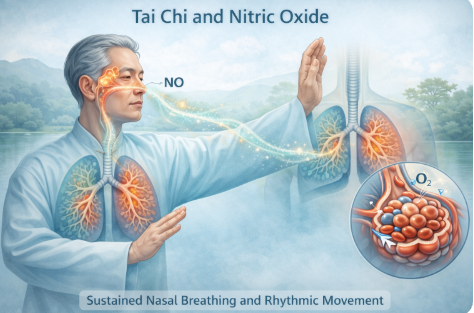
Tai Chi provides a practical example of how breathing and movement interact to support nitric oxide physiology. Most Tai Chi forms are performed at a low to moderate intensity, allowing sustained nasal breathing throughout practice.
From a nitric oxide perspective, Tai Chi combines continuous nasal airflow with rhythmic, low-stress movement. This allows nitric oxide-mediated effects on pulmonary circulation and oxygen utilization to remain active, rather than being overridden by stress responses associated with higher-intensity exercise.
Clinical studies consistently report improvements in blood pressure, endothelial function, and autonomic regulation with Tai Chi, outcomes that align with nitric oxide–dependent vascular mechanisms. Although nitric oxide is not typically measured directly in these studies, the physiological changes observed are consistent with improved nitric oxide signaling.
The objective in Tai Chi is not increased ventilation or intensity, but efficiency. By maintaining nasal breathing during movement, Tai Chi creates conditions where nitric oxide can support circulation, oxygen delivery, and movement quality. This makes it particularly relevant for individuals where physiological efficiency matters more than raw output, including those with chronic pain, deconditioning, or cardiometabolic sensitivity.
The Power of Nitric Oxide, At a Glance
Nitric oxide is a small, short-lived molecule with outsized influence on human physiology. When supported through nasal breathing and efficient movement, it contributes to several core aspects of health and performance:
Improved oxygen utilization, by enhancing ventilation–perfusion matching in the lungs
Healthier circulation, through nitric oxide–mediated vasodilation and endothelial support
Better autonomic regulation, promoting calm, efficient breathing under physical demand
Enhanced movement efficiency, reducing unnecessary respiratory and muscular effort
Support for immune and vascular resilience, particularly with consistent nasal breathing
Together, these effects help explain why breathing strategies that support nitric oxide can meaningfully influence recovery, performance, and long-term health.

Many of the mechanisms discussed in this article, particularly the role of nitric oxide in breathing, circulation, and movement efficiency, are explored in greater depth in my upcoming book, Trajectory: The Power of Everyday Choices, scheduled for release in late 2026 or early 2027. A dedicated chapter on breath goes beyond theory, providing specific, practical breathing and movement-based exercises that readers can perform to support nitric oxide physiology, improve regulation, and integrate these principles into daily life, rehabilitation, and long-term health strategies.
References
Lundberg JO, Weitzberg E, et al. Primarily nasal origin of exhaled nitric oxide… Eur Respir J. 1994;7(8):1501–1504.
Weitzberg E, Lundberg JO. Nasal nitric oxide in man. Thorax. 2002;57(10):885–888.
Ignarro LJ, Buga GM, et al. Endothelium-derived relaxing factor… PNAS. 1987;84(24):9265–9269.
Lundberg JO, Gladwin MT, Weitzberg E. Strategies to increase nitric oxide signaling… Nat Rev Drug Discov. 2015;14:623–641.
Montero D, Walther G, Stebbings GK. Role of nitric oxide in exercise performance… J Physiol. 2017;595(24):7017–7025.
Song Q, Wang X, et al. Effect of Tai Chi on cardiovascular risk factors… Eur J Prev Cardiol. 2021;28(12):1329–1340.
Yeh GY, Wang C, et al. Influence of Tai Chi on physical function… J Am Geriatr Soc. 2008;56(6):1134–1142.
Tranchita E, Cocco L, et al. Effect of a Pilates and Tai Chi training program on HRV… J Sports Med Phys Fitness. 2015;55(3):280–286.
DR. BRIAN ABELSON, DC. - The Author

With over 30 years of clinical experience and more than 25,000 patients treated, Dr. Brian J. Abelson is the creator of Motion Specific Release (MSR), a multidisciplinary assessment and treatment system that integrates biomechanics, fascia science, neurology, manual therapy, exercise rehabilitation, and acupuncture. He is an internationally recognized best-selling author of 10 books and 200+ articles, and has trained healthcare professionals through structured MSR courses and clinical education programs throughout Canada and the United States. Dr. Abelson practices at Kinetic Health in Calgary, Alberta, and continues to develop educational resources focused on long-term function, resilience, and the health trajectory shaped by everyday choices.
For patients, his goal is simple, reduce pain, restore movement, and build long-term independence. For practitioners, MSR provides a practical framework you can integrate directly into daily clinical care.

Why Choose MSR Courses and MSR Pro?
Elevate your clinical practice with Motion Specific Release (MSR) training and MSR Pro, a comprehensive, evidence-informed approach to musculoskeletal assessment and treatment designed to improve diagnostic precision, hands-on skill, and patient outcomes.
MSR proficiency goes far beyond videos and articles. True clinical mastery requires hands-on training, refinement of palpation and force application, and a deeper command of applied anatomy and biomechanics. MSR is a skill-based system built through deliberate practice, real-time feedback, and mentorship, where clinical reasoning and tactile execution come together.
Here’s why practitioners join MSR:
Proven Clinical SystemDeveloped by Dr. Brian J. Abelson, DC, with over 30 years of clinical experience and more than 25,000 patients treated, MSR integrates the most effective components of osseous and myofascial therapies into a cohesive, repeatable framework. The system is grounded in clinical logic and supported by patient outcomes, with a clinic success rate exceeding 90% in decreasing pain and improving function.
Comprehensive, Practical TrainingCourses blend rigorous clinical education with hands-on technique development. You’ll strengthen orthopedic and neurological examination skills while learning targeted myofascial procedures, fascial expansion concepts, and osseous adjusting and mobilization strategies that translate directly into daily practice.
MSR Pro, Your Clinical LibraryAs an MSR Pro subscriber, you gain access to a growing library of 200+ MSR procedures, instructional videos, downloadable and fillable clinical forms, and in-depth practitioner resources that support the full clinical workflow, from intake to reassessment and exercise prescription.
Ongoing Support and UpdatesMSR Pro includes an extensive resource base of 750+ videos, including technique instruction, rehabilitation exercise progression, and clinical application guidance, supported by a large MSK article library and condition-based resources. Content is actively updated and expanded to reflect evolving clinical needs and course development.
A System Built for GrowthMSR is designed to help practitioners think clearly in complex presentations, develop adaptable strategies, and evolve as clinicians. This approach aligns with the broader Trajectory principle, better outcomes are built through the cumulative power of consistent, high-quality clinical decisions.
Unlock your practice’s full potential with MSR Courses and MSR Pro, and join a community of practitioners committed to excellence in musculoskeletal care.

YouTube Channel
Explore Dr. Abelson’s YouTube channel, Kinetic Health Online, with 200,000+ subscribers and 37+ million views.
The channel features a large library of evidence-informed musculoskeletal education, including Motion Specific Release (MSR) procedures that integrate fascial-based concepts, manual therapy, movement science, and select Traditional Chinese Medicine (TCM) principles.
You’ll also find:
70+ essential physical examination videos
MSK condition tutorials and clinical education content
Hundreds of mobility, strengthening, and rehab exercise demonstrations
A dedicated Yang Style Tai Chi playlist, reflecting Dr. Abelson’s decades of teaching experience
Disclaimer:
The content on the MSR website, including articles and embedded videos, is provided for educational and informational purposes only and is not a substitute for individualized medical advice, diagnosis, or treatment. MSR techniques require appropriate professional training; do not attempt or apply these procedures unless you are properly trained and licensed where applicable. By accessing this content, you assume full responsibility for your use of the information, and to the fullest extent permitted by law, the authors and contributors disclaim liability for any loss, injury, or damages arising from its use.
This website does not establish a healthcare provider–patient relationship. If you have a medical concern, consult a qualified, licensed healthcare professional. This website is intended for adults and is not directed to individuals under 18. The MSR website may include links to third-party sites; we do not control and are not responsible for the content, accuracy, or practices of external websites.
By using this website, you agree to indemnify and hold harmless the authors and contributors from any claims, liabilities, and legal fees arising from your use of the site or violation of these terms. For more information, please review the full disclaimer and policies on this website.


Comments